


THCA

THCA Effects: Benefits, Side Effects, and Potential Risks
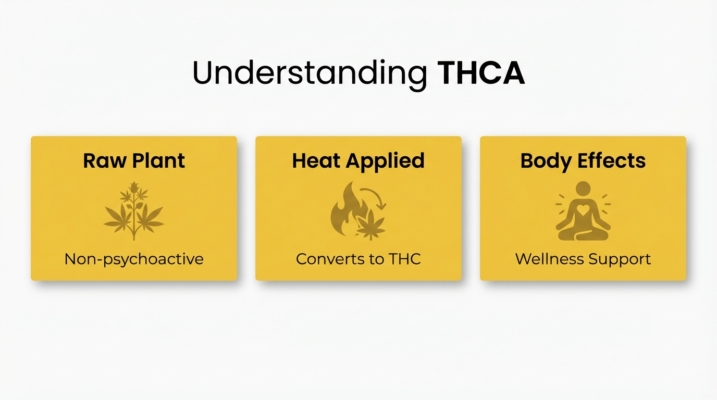
THCA is a non-psychoactive cannabinoid acid found in raw cannabis that converts to psychoactive…
Learn more
You must be 21+ to enter this site
 FREE SHIPPING $89+
 FREE SODA ON $120+
 100% FEDERALLY LEGAL
 LAB TESTED FOR PURITY
FREE SHIPPING $89+
FREE SODA ON $120+
100% FEDERALLY LEGAL
LAB TESTED FOR PURITY
FREE SHIPPING $89+
FREE SODA ON $120+
100% FEDERALLY LEGAL
LAB TESTED FOR PURITY
FREE SHIPPING $89+
FREE SODA ON $120+
100% FEDERALLY LEGAL
LAB TESTED FOR PURITY
FREE SHIPPING $89+
FREE SODA ON $120+
100% FEDERALLY LEGAL
LAB TESTED FOR PURITY
FREE SHIPPING $89+
FREE SODA ON $120+
100% FEDERALLY LEGAL
LAB TESTED FOR PURITY
LAB TESTED FOR PURITY
FREE SHIPPING $89+
FREE SODA ON $120+
100% FEDERALLY LEGAL
LAB TESTED FOR PURITY
FREE SHIPPING $89+
FREE SODA ON $120+
100% FEDERALLY LEGAL
LAB TESTED FOR PURITY
FREE SHIPPING $89+
FREE SODA ON $120+
100% FEDERALLY LEGAL
LAB TESTED FOR PURITY
FREE SHIPPING $89+
FREE SODA ON $120+
100% FEDERALLY LEGAL
LAB TESTED FOR PURITY
FREE SHIPPING $89+
FREE SODA ON $120+
100% FEDERALLY LEGAL
LAB TESTED FOR PURITY

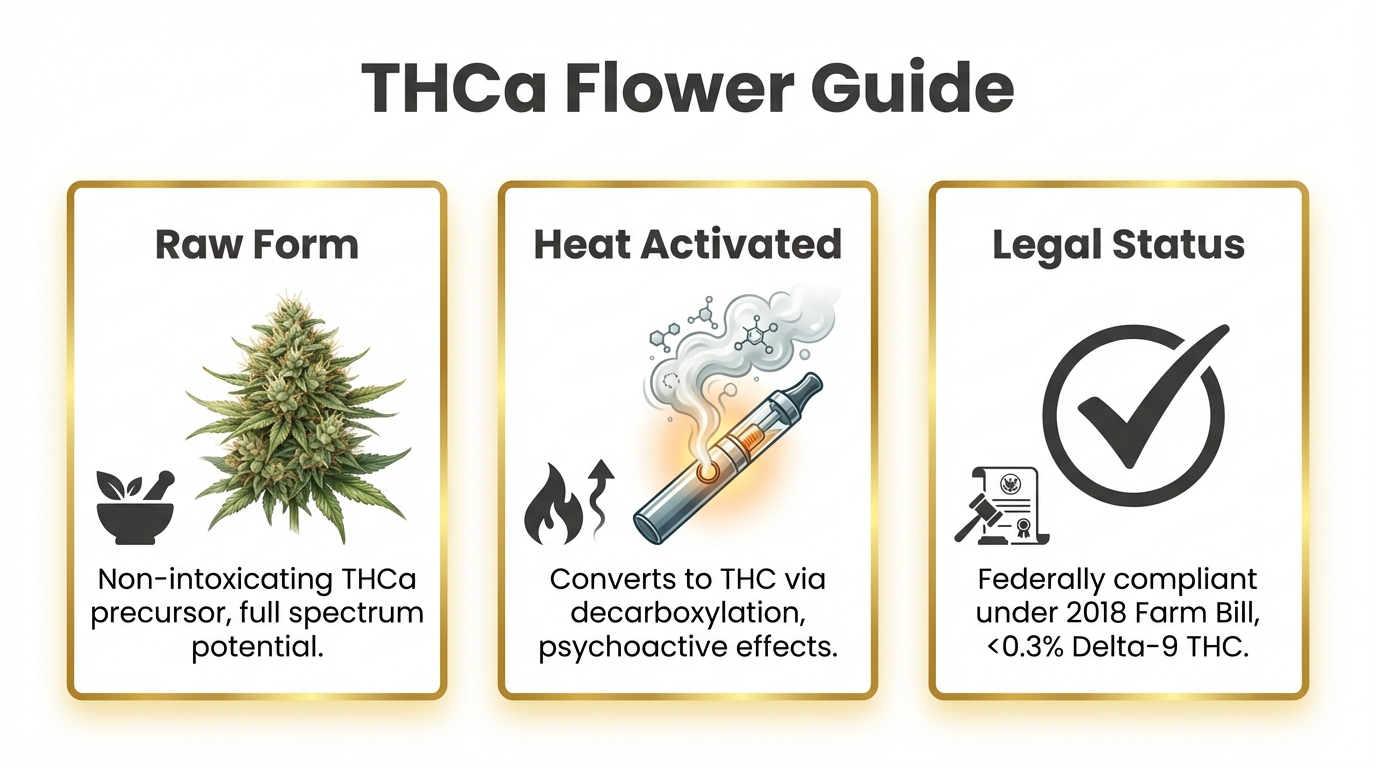
THCa flower is raw cannabis hemp that contains high concentrations of tetrahydrocannabinolic acid, a non-psychoactive cannabinoid that converts to THC when exposed to heat.
This guide covers the science behind THCa and its legal status, its wellness benefits in both raw and heated form, the strain varieties available, how to evaluate flower quality, proper usage and storage, and what to prioritize when buying online.
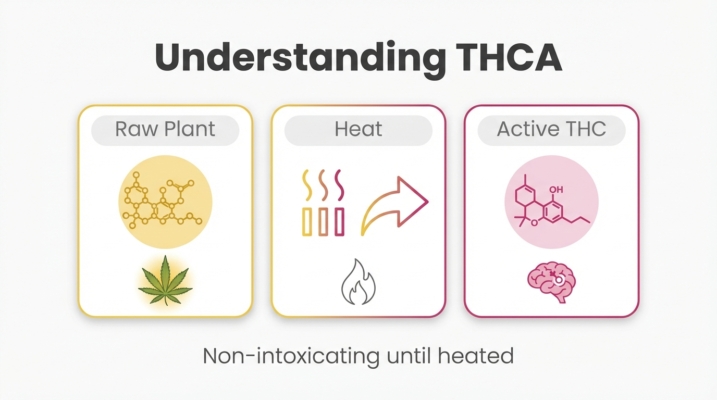
THCa carries an extra carboxyl group that prevents it from binding to CB1 receptors, which is why raw flower produces no high. Heat breaks that group off through decarboxylation, converting THCa into delta-9 THC. Federal law defines hemp as Cannabis sativa with no more than 0.3% delta-9 THC on a dry weight basis, yet the DEA has challenged whether high-THCa flower truly qualifies, and some states include THCa in total THC calculations.
Raw THCa shows preclinical promise for anti-inflammatory activity, nausea reduction, and neuroprotective support through PPARγ receptor activation. Smoking or vaping the same flower delivers traditional psychoactive effects. This dual nature gives consumers flexibility depending on whether they seek clear-headed wellness support or full cannabis-style relief.
THCa flower comes in indica, sativa, and hybrid varieties, each shaped by distinct terpene profiles. Myrcene-rich indicas lean sedating, while limonene-forward sativas tend toward uplift. Evaluating quality means verifying third-party lab results, reviewing Certificates of Analysis for cannabinoid and contaminant panels, and inspecting physical traits like trichome coverage and aroma.
Proper storage in airtight glass containers at cool temperatures preserves both potency and terpene integrity. When purchasing online, vendor transparency, discreet shipping, batch-matched lab reports, and clear return policies separate reliable retailers from risky ones.
THCa is the naturally occurring acidic precursor of THC found in raw cannabis. The sections below cover its chemical structure, the heat-driven conversion process, and the legal distinction between the two cannabinoids.
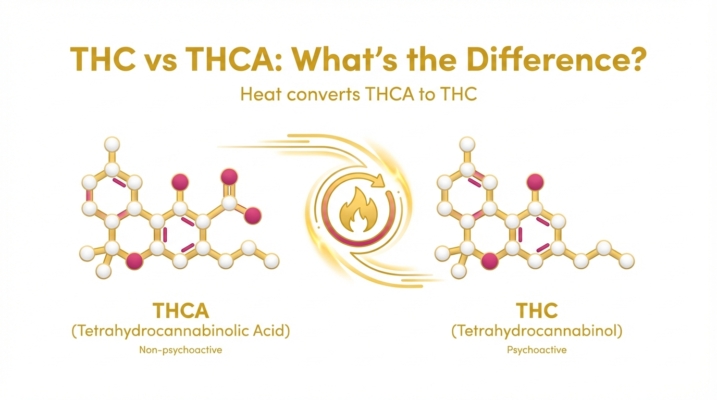
The chemical structure of THCa before decarboxylation includes an extra carboxyl group (COOH) attached to the molecule that THC lacks. Its chemical formula is C22H30O4, and its IUPAC name is (6aR,10aR)-1-Hydroxy-6,6,9-trimethyl-3-pentyl-6a,7,8,10a-tetrahydro-6H-benzo[c]chromene-2-carboxylic acid, according to its Wikipedia chemical profile. This carboxyl group prevents THCa from binding efficiently to CB1 receptors in the brain, which is why raw cannabis flower does not produce psychoactive effects. Once heat removes that group, the smaller THC molecule fits CB1 receptors and triggers intoxication.
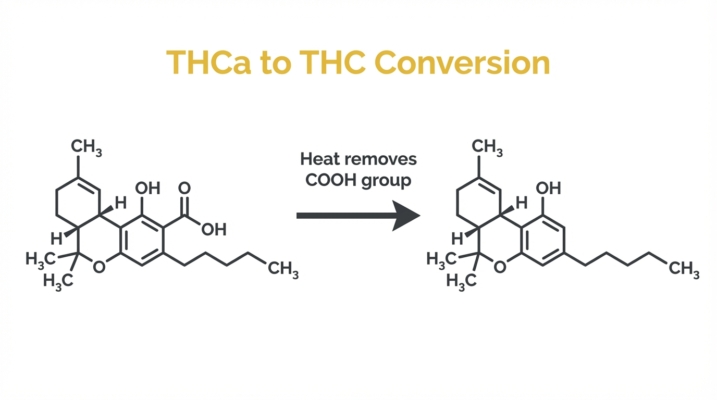
THCa converts to THC through heat in a process called decarboxylation. When cannabis flower is smoked, vaped, or baked, thermal energy breaks the carboxyl group off the THCa molecule, releasing CO₂ and leaving behind delta-9 THC. According to Leafly, effective cannabis decarboxylation occurs between 200 and 245°F, with a recommended oven temperature of 220°F for 30 to 40 minutes when preparing edibles. This conversion is why THCa flower can be sold as non-psychoactive hemp yet deliver traditional THC effects once ignited. For anyone purchasing raw flower, understanding this thermal threshold is essential to predicting the actual experience.
The legal distinction between THCa and delta-9 THC centers on how federal law defines “hemp.” Under 7 U.S.C. § 1639o, hemp is Cannabis sativa containing no more than 0.3% delta-9 THC on a dry weight basis. Because THCa is not delta-9 THC in its raw form, flower testing below that threshold has been sold as federally compliant hemp.
However, the DEA has challenged this interpretation. According to a 2024 report by Marijuana Moment, the DEA stated that cannabis-derived THCa does not meet the definition of hemp because, upon conversion, it is equivalent to delta-9 THC. This creates a regulatory gray area that buyers should monitor closely. With federal guidance still evolving, understanding how your state calculates total THC determines whether THCa flower is accessible where you live.
The benefits of THCa flower span anti-inflammatory support, nausea relief, and neuroprotective potential when consumed in its raw, non-psychoactive form. Below, each benefit is explored alongside how consumption method changes the experience.
The potential wellness benefits of raw THCa include anti-inflammatory activity, nausea reduction, appetite modulation, and neuroprotective support. Because raw THCa has not undergone decarboxylation, it retains its carboxylic acid group and does not produce psychoactive effects. This makes raw consumption appealing for those who want cannabinoid support without intoxication. Common methods include adding raw flower to smoothies, juicing fresh cannabis leaves, or using tinctures held at low temperatures. For wellness-focused consumers, raw THCa offers a way to explore the plant’s therapeutic profile while remaining clear-headed throughout the day.
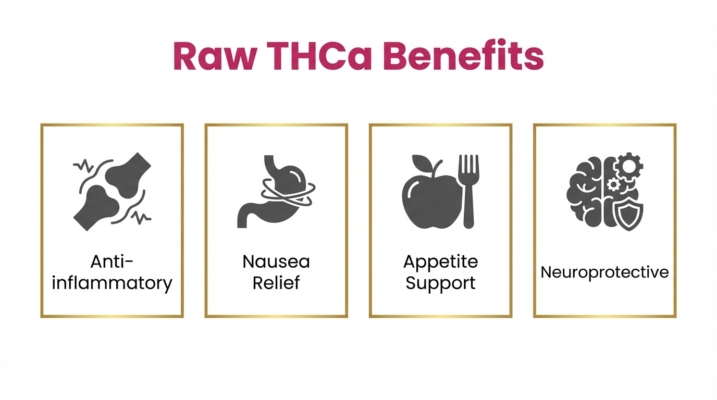
THCa may support anti-inflammatory responses by interacting with pathways that regulate immune signaling, particularly COX-2 enzyme activity and pro-inflammatory cytokine production. Preclinical research suggests THCa modulates these pathways without binding strongly to CB1 receptors, which is why it does not produce a high. This mechanism distinguishes it from THC, whose anti-inflammatory effects come alongside psychoactivity. For individuals managing joint discomfort, exercise recovery, or chronic inflammatory conditions, raw THCa flower represents a non-intoxicating option worth discussing with a healthcare provider. While human clinical trials remain limited, the early evidence positions THCa as one of the more promising non-psychoactive cannabinoids for inflammation-related wellness.
Yes, THCa flower can help with nausea and appetite based on preclinical findings. Animal studies indicate that THCa interacts with serotonin receptors involved in nausea signaling, potentially reducing the urge to vomit at doses lower than those required for THC to achieve the same effect. This is particularly relevant for individuals undergoing treatments that cause severe nausea, where avoiding psychoactive side effects is preferred. Appetite stimulation, often associated with THC, may also occur with THCa through indirect endocannabinoid system modulation. Consuming raw THCa flower in food or beverages preserves the acid form, keeping these potential benefits accessible without intoxication.
The neuroprotective properties linked to THCa involve its ability to activate PPARγ receptors, which play a role in reducing neuroinflammation and oxidative stress. Preclinical models of neurodegenerative conditions suggest THCa may help protect neurons from damage caused by inflammatory cascades. This antioxidant capacity, combined with its non-psychoactive profile, makes THCa a subject of growing interest in neurological research. Although no human clinical trials have confirmed these effects, the preclinical data is encouraging for conditions where chronic brain inflammation contributes to disease progression. Raw consumption preserves THCa’s acid structure, which appears essential for this particular protective mechanism.
Smoking THCa flower converts THCa into THC through heat exposure, a process called decarboxylation. According to Leafly, decarboxylation occurs between 200 and 245°F, transforming the non-psychoactive acid into the psychoactive compound responsible for cannabis’s intoxicating effects. Smoking therefore delivers a traditional cannabis experience, while raw consumption preserves THCa’s acid form and its associated non-psychoactive benefits. The choice between methods depends on the desired outcome: psychoactive relief and euphoria favor smoking, whereas anti-inflammatory, antiemetic, and neuroprotective support without intoxication favor raw ingestion. Many users alternate between both methods depending on the time of day or specific wellness goal. Understanding this distinction helps consumers match their consumption method to the benefits they prioritize most.
The different THCa flower strains available fall into three primary categories: indica, sativa, and hybrid. Each category produces distinct effects shaped by its unique terpene and cannabinoid profile.
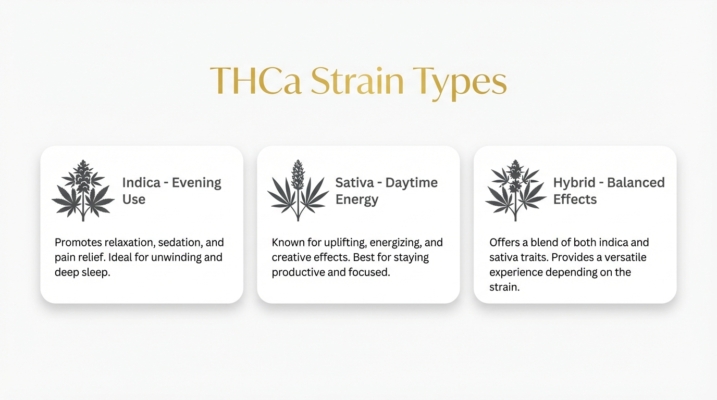
Indica THCa strains are cannabis varieties known for producing deeply relaxing, body-focused effects. These strains typically contain higher concentrations of myrcene, the terpene most associated with sedation and physical calm. Indica THCa flower is often chosen for evening use, when unwinding or preparing for sleep is the goal.
For anyone seeking reliable nighttime relief, indica strains consistently deliver the most pronounced physical relaxation among all THCa flower categories.
Sativa THCa strains are varieties of Cannabis sativa that tend to produce uplifting, cerebral effects. According to a study published by the National Center for Biotechnology Information, THCA-A is the acidic precursor of THC, the main psychoactive compound found in Cannabis sativa. When sativa THCa flower is smoked or vaporized, this conversion produces effects commonly described as energizing and creativity-enhancing.
Sativa strains suit daytime activities, social settings, and tasks requiring sustained mental focus.
Hybrid THCa strains are crossbreeds of indica and sativa genetics, engineered to balance both relaxing and energizing effects. Breeders develop hybrids to target specific terpene ratios and cannabinoid concentrations, creating profiles tailored to particular needs.
Hybrids are classified as either indica-dominant, sativa-dominant, or balanced, depending on their parent genetics:
This versatility makes hybrids the most popular choice for consumers exploring THCa flower for the first time. Understanding strain type helps when evaluating flower quality and potency.
You choose high-quality THCa flower by verifying lab results, evaluating terpene profiles, and inspecting physical quality. The following subsections cover third-party testing, certificates of analysis, terpene and potency evaluation, and signs of poor cultivation or storage.
Third-party lab tests matter for THCa flower because they provide an unbiased verification of cannabinoid content, contaminant levels, and overall safety. Unlike in-house testing, independent laboratories have no financial incentive to manipulate results, which makes their findings more reliable for consumers.
These tests screen for critical concerns:
Without independent verification, potency claims on labels remain unsubstantiated. For any THCa flower worth purchasing, a current, accessible third-party lab report should be non-negotiable. IndaCloud makes third-party lab results accessible for every batch through detailed Certificates of Analysis, allowing customers to verify cannabinoid content, terpene profiles, and contaminant screening before purchasing.
A Certificate of Analysis (COA) should reveal the precise cannabinoid breakdown, contaminant screening results, and batch-specific identification for THCa flower. This document serves as the product’s full transparency record.
Key elements to look for on a COA include:
If a COA is outdated, missing panels, or cannot be matched to your specific batch, treat it as a red flag.
You can evaluate terpene profiles and potency by reviewing the lab-tested terpene breakdown and total THCa percentage listed on the COA. Terpenes shape a strain’s aroma, flavor, and the character of its effects. According to Fresh Bros, myrcene is the most common cannabis terpene, often comprising 20–50% of a strain’s terpene profile, with high myrcene content above 0.5% associated with more sedating effects.
When assessing potency, look for total THCa percentages alongside the terpene data. A high THCa number alone does not guarantee a quality experience; the interplay between cannabinoids and terpenes, often called the entourage effect, determines the overall character. Strains rich in limonene tend toward uplifting effects, while linalool-dominant profiles lean calming. Matching these profiles to your desired outcome matters more than chasing the highest potency number.
The signs of poorly grown or stored THCa flower include visual defects, off-putting aromas, and structural degradation that indicate compromised quality.
Watch for these warning signs:
Proper storage requires airtight containers kept away from direct light, heat, and humidity. Flower exposed to these elements degrades rapidly, losing both terpenes and cannabinoid potency. When in doubt, purchasing from vendors who provide full COAs and store inventory under controlled conditions remains the safest approach.
IndaCloud ships all THCa flower from climate-controlled facilities within 48 hours of order placement, ensuring products arrive fresh with maximum cannabinoid and terpene preservation.
With quality markers established, understanding the legal landscape helps ensure your purchase is also compliant.
THCa flower occupies a complex legal space in the United States. Federal hemp law and individual state regulations create a patchwork of rules that directly affect legality. The sections below explain how the 2018 Farm Bill applies and which states impose restrictions.
The 2018 Farm Bill applies to THCa flower through its legal definition of hemp. According to the Cornell Law School Legal Information Institute, the law defines hemp as Cannabis sativa L. with a delta-9 THC concentration of not more than 0.3 percent on a dry weight basis. Because THCa is not delta-9 THC, flower testing below that threshold can technically qualify as legal hemp.
This distinction has created significant debate. As reported by Marijuana Moment, the DEA has stated that cannabis-derived THCa does not meet the definition of hemp under the Controlled Substances Act because, upon conversion for identification purposes as required by Congress, it is equivalent to delta-9 THC. This position directly challenges the legal framework many THCa retailers rely on. The tension between the Farm Bill’s text and federal enforcement interpretation makes this one of the most unsettled areas in cannabinoid law.
Several states have restrictions on THCa hemp products, even when the flower meets federal hemp testing standards. Some states calculate total THC by combining THCa and delta-9 THC concentrations, which effectively bans high-THCa flower. Arkansas, for example, includes THCa in total THC calculations, making THCa flower unlawful in that state.
Other states with notable restrictions include:
Because state laws change frequently, buyers should verify current regulations in their specific state before purchasing. This regulatory variability is precisely why working with transparent vendors who track compliance across jurisdictions matters.
You properly use and store THCa flower by choosing a consumption method that matches your desired effect and keeping flower in airtight, light-protected containers. The sections below cover consumption methods, storage best practices, and beginner dosing.
The most common ways to consume THCa flower are smoking, vaporizing, and incorporating raw flower into foods or smoothies. Smoking or vaping applies heat, which triggers decarboxylation and converts THCa into psychoactive THC. Consuming flower raw preserves the acidic cannabinoid in its non-psychoactive form, appealing to those seeking wellness benefits without intoxication.
Terpene profiles also shape the experience. According to Fresh Bros, myrcene is the most common cannabis terpene, often comprising 20–50% of a strain’s terpene profile, with concentrations above 0.5% linked to more sedating effects. Choosing strains by terpene content helps tailor results, whether you prioritize relaxation or alertness.
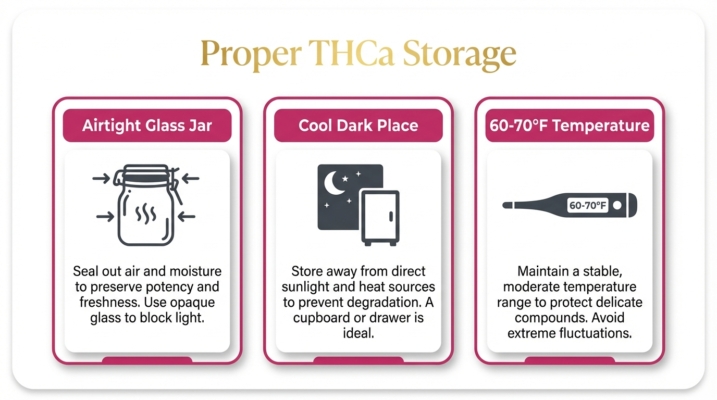
You should store THCa flower in an airtight glass jar, kept in a cool, dark location away from direct sunlight and heat sources. Exposure to light, heat, or oxygen accelerates decarboxylation, gradually converting THCa into THC and degrading potency over time.
Ideal storage conditions include:
Avoid plastic bags, which generate static that strips trichomes from the flower surface. Proper storage preserves both the cannabinoid profile and terpene integrity for weeks or months.
A beginner should start with a small amount, typically one or two short inhalations if smoking or vaping THCa flower. Because heat converts THCa to THC during combustion, even flower labeled as high-THCa can produce strong psychoactive effects once lit.
For raw consumption, where no decarboxylation occurs, beginners can start with a slightly larger portion since THCa itself is non-intoxicating. Waiting 15–30 minutes between inhalations allows time to gauge individual tolerance before consuming more. Factors such as body weight, prior cannabis experience, and the strain’s total THCa percentage all influence how a given dose feels. Starting low and increasing gradually remains the safest approach for anyone new to THCa flower.
With consumption and storage methods established, selecting a trustworthy source ensures the flower you receive is worth preserving.
The difference between THCa flower and CBD flower lies in their dominant cannabinoid, psychoactive potential, and legal treatment. THCa flower contains high concentrations of tetrahydrocannabinolic acid, which converts to psychoactive THC when heated. CBD flower contains high concentrations of cannabidiol, a non-intoxicating cannabinoid that does not convert into THC regardless of heat exposure.
Both products derive from Cannabis sativa cultivated under the 2018 Farm Bill’s hemp definition. As defined by Cornell Law School’s Legal Information Institute, “hemp” means Cannabis sativa with a delta-9 THC concentration of not more than 0.3 percent on a dry weight basis. While both flowers can test below this threshold in raw form, their behavior after consumption diverges significantly.
The key distinctions between THCa flower and CBD flower include:
For consumers choosing between the two, the decision often comes down to whether psychoactive effects are desired. THCa flower suits those seeking a full cannabis experience within a federally compliant framework, while CBD flower appeals to users who want cannabinoid support without any intoxication. Understanding your state’s specific THC calculation method is equally important, since it determines which product is legally accessible where you live.
When buying THCa flower online, you should look for vendor transparency, reliable shipping practices, and strong customer guarantees. The sections below cover how to evaluate a vendor’s credibility, what discreet shipping involves, and which return policies protect your purchase.
Vendor transparency is important when shopping online because it lets you verify product quality, legality, and safety before committing to a purchase. Trustworthy vendors publish third-party lab results, known as Certificates of Analysis, directly on their product pages. These reports confirm cannabinoid potency, terpene content, and the absence of contaminants like pesticides or heavy metals.
A transparent vendor also clearly states where its hemp is grown, how flower is processed, and whether delta-9 THC levels remain at or below the 0.3% federal threshold. Without this openness, there is no reliable way to distinguish premium THCa flower from untested, potentially non-compliant products. Prioritizing vendors who make lab data easy to find is the single most effective way to protect both your health and your legal standing.
Discreet shipping for hemp-derived products works by using plain, unmarked packaging that conceals the contents from outside view. Reputable retailers ship THCa flower in sealed, odor-proof containers placed inside nondescript boxes with no branding or product descriptions visible on the exterior.
Most vendors include compliance documentation inside the package, such as a copy of the Certificate of Analysis and a note confirming the product meets the federal hemp definition under 7 U.S.C. § 1639o, which requires delta-9 THC concentration of not more than 0.3% on a dry weight basis. This paperwork helps resolve any questions during transit. Look for retailers that process orders quickly, ideally within 48 hours, and provide shipment tracking so you can monitor delivery from warehouse to doorstep.
IndaCloud includes compliance documentation with every shipment and offers free shipping on orders over $89, delivering across the continental United States in nondescript packaging that protects customer privacy.
The return policies and guarantees you should expect include satisfaction guarantees, clearly stated return windows, and responsive customer support. At minimum, a credible online vendor should offer a refund or replacement if the product arrives damaged, unsealed, or significantly different from its description.
Key protections to look for before placing an order include:
Vendors who stand behind their flower with clear guarantees signal confidence in their supply chain. If a retailer hides its return policy or makes refunds nearly impossible, that alone is reason enough to shop elsewhere. With these buying criteria established, finding a retailer that meets every standard becomes the final step.
You can find premium lab-tested THCa flower online through vendors that prioritize third-party testing, federal compliance, and transparent sourcing. Inda Cloud stands out as a trusted option, with delivery details and key buying takeaways covered below.
Yes, Inda Cloud offers federally legal THCa flower delivered directly to your door across the continental United States. All Inda Cloud flower contains less than 0.3% delta-9 THC on a dry weight basis, aligning with the federal hemp definition. Every batch undergoes third-party lab testing, with Certificates of Analysis available for customers to verify potency, purity, and cannabinoid content before purchasing.
Inda Cloud ships orders within 48 hours in nondescript packaging, and qualifying orders over $89 receive free shipping. The selection includes indica, sativa, and hybrid THCa strains. However, legality varies by state; according to a 2025 state-by-state guide from High Score Hemp, some states like Arkansas include THCa in total THC calculations, making THCa flower unlawful there. Checking your state’s specific regulations before ordering is essential.
The key takeaways about THCa flower benefits and buying center on quality verification, legal awareness, and matching products to your needs. When shopping for THCa flower online, keep these priorities in focus:
For anyone prioritizing convenience alongside verified quality, Inda Cloud provides lab-tested, federally compliant THCa flower with fast, discreet nationwide delivery.
THCA is a non-psychoactive cannabinoid acid found in raw cannabis that converts to psychoactive…
Learn more
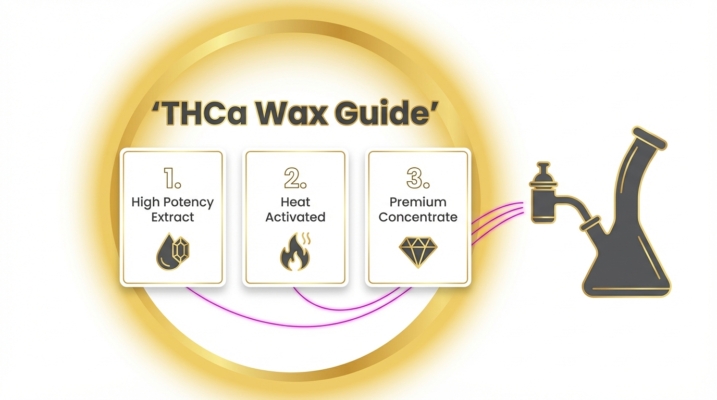
THCa wax is a cannabis concentrate containing high levels of tetrahydrocannabinolic acid in a…
Learn more
THC and THCA percentages are laboratory measurements that indicate the psychoactive potency and raw…
Learn more
THCA (tetrahydrocannabinolic acid) is a non-intoxicating cannabinoid found naturally in raw cannabis and hemp…
Learn more


